Copyright © 1998-2026
ieLogical
All Rights Reserved

Audiophilia Redux
... old habits die hard ... begun c. 2003, last updated October 2024
History
c. 1957
Music has always been a very important element in my life. Mom played piano, Dad always sang fortissimo in church and we had Benny Goodman, Harry James, Al Hirt and a host of others to entertain us. For as long as I can remember, I enjoyed the HiFi aspect of music reproduction. In the 50's, my dad had a Bogen mono tube amp driving a 12" University co-ax in a box he built that seemed to weigh a ton. It took two grown men to move it. The turntable, a Bogen/Lenco, had a flip over 'needle' for 78s OR 45s and LPs aka MicroGroove... all mounted in custom built hand finished mahogany cabinetry... in those days HiFi was furniture!
My earliest tweaking recollection is changing the Phono EQ curve knob to obtain the best sound from Harry James, Benny Goodman, Glenn Miller...
My earliest tweaking recollection is changing the Phono EQ curve knob to obtain the best sound from Harry James, Benny Goodman, Glenn Miller...
⇒ ~10 years - c. 1967
We replaced the old Bogen with a Sansui 35w amp, a Dual 1019 and an additional 12" University. Excited as we were to have Stereo...
⇒ ~10 years - c. 1977
Oracle TT, db preamp, Ampzilla, Dahlquists. A slow learner, it began to penetrate my cranium that printed specs are essentially worthless and the paper better employed elsewhere. [Like counterfeiting, to support an audio habit!] Watts RMS, 0.000% distortion, .1Hz to 1MHz bandwidth, ±.01db ruler flat frequency response, massive damping factor specs are all so much twaddle. There is frequently very little correlation between the musicality of a device and how it is measured.
"If it measures good and sounds bad, –– it is bad. If it sounds good and measures bad, –– you've measured the wrong thing." ––
Daniel R. von Recklinghausen, Wikipedia
⇒ ~10 years - c. 1987
Biamped Tympani IVs, Goldmund TT, Syrinx tonearm, Conrad-Johnson HA, Michael Fisher customized Audio Research SP-6[a?b?c?] and his custom 70w quad KT‑88 1KW PS power amp w Marantz 9 output transformers, Nikko 350W/Ch woofer amp, Monster Cables and Cartridge[s], VPI Bricks [1982 Stereophile review]. LAST, Nitty Gritty Record Cleaning Machine... you get idea. The turntable and pre-amp electronics are in a separate room. The Goldmund has its own support anchored to the concrete and the Tympanis are supported on spikes to ensure rigid floor coupling. The power amps stack is placed between the speakers for minimum cable length.
None of which are relevant as individual items. It's pointless to ask for gear recommendations in isolation as pieces must integrate into the SYSTEM in the ROOM on the listener's PREFERRED PROGRAM!!
On well recorded material, this system could raise the hair on the back of your neck. One felt as though one could walk up and join the band playing in the room, be it a Ben Webster trio, Queen or the London Phil... some said it sounded too good...
OTT? Not a chance!
None of which are relevant as individual items. It's pointless to ask for gear recommendations in isolation as pieces must integrate into the SYSTEM in the ROOM on the listener's PREFERRED PROGRAM!!
On well recorded material, this system could raise the hair on the back of your neck. One felt as though one could walk up and join the band playing in the room, be it a Ben Webster trio, Queen or the London Phil... some said it sounded too good...
OTT? Not a chance!
⇒ ~15 years - c. 2003
The above are long since gone and we enjoyed our 1985 vintage Nikko NR-850 65w/ch receiver. Generally euphonious with
Spica TC-50s and Monster interconnects. Warm, cohesive sound with a decent stage.
Sadly the Nikko started to lose FM signals. We tried a Technics receiver of about the same vin/wat/tage. A few weeks later we decided it had to go. No amount of burn-in was going to tame this beast. Abrasive highs, honky mids, anemic bass, one dimensional. Amusical? In Spades!
One sunny Saturday I pluck up my courage and decide to beard the 'HiFi' salesman in his den. As I approach BOF [Balding Old Fart] status in the eyes of your typical audio emporia purveyor, I did not relish the prospect of the puerile prattle emanating therefrom. Gimme the freakin' remote and p... off!
A sextet of shops later and I'm beginning to think I'll stick with the Nikko, flaky FM and all. Onkyo, Denon, Sony, Yamaha, Marantz receivers auditioned in the 50 to 100w class are not made for the serious reproduction of music. Regardless of loudspeaker, each frequency band appears cut from diverse and threadbare cloth. All exhibit a multiplicity of grating flaws and sonic character defects disqualifying them from any consideration.
On a nostalgic whim or in sheer desperation delerium, I decided to enter Shelley's Stereo, our local High End outlet. Known for big dollar systems, I had no hope of finding anything for the pittance I planned to expend. I thought perhaps just a tiny fix of auditory titillation would settle the jitters. After all, I've been clean on the AA [Audiophiles Anonymous] wagon for over 15 years and should be able to handlejust one listen.
Zach Zoschke, Audio Consultant [really!], approached and asked if he could help. "A musical 2 channel receiver of 50 watts, if you please." He turned on the Rotel RX-1050, handed me the remote and stepped aside. [You could have knocked me over with a feather.] I listened a while, changed loudspeakers a couple of times. I then requested he play some of the aforementioned. A few bars later, all I said was "How much?" While close to treble the cost of the others auditioned, the RX-1050 is worth every sou and an unqualified bargain to boot! Excellent sound stage, cohesive sonic fabric. In one word, Musical! I could wax enthusiastic for kilobytes but fear not, dear reader, for I shall come to the point of this missive lest I render you sonambulant.
After a judicious week long burn in period, we began to seriously audition our new receiver and Rotel RCD-02 Player. Both devices require a warm-up to avoid the Winter Blues before listening. Impatience will reward the listener with an overall diminished stage and an especially congested nasality on dense orchestral material. Some claim cables also exhibit similar perturbations...
Sadly the Nikko started to lose FM signals. We tried a Technics receiver of about the same vin/wat/tage. A few weeks later we decided it had to go. No amount of burn-in was going to tame this beast. Abrasive highs, honky mids, anemic bass, one dimensional. Amusical? In Spades!
One sunny Saturday I pluck up my courage and decide to beard the 'HiFi' salesman in his den. As I approach BOF [Balding Old Fart] status in the eyes of your typical audio emporia purveyor, I did not relish the prospect of the puerile prattle emanating therefrom. Gimme the freakin' remote and p... off!
A sextet of shops later and I'm beginning to think I'll stick with the Nikko, flaky FM and all. Onkyo, Denon, Sony, Yamaha, Marantz receivers auditioned in the 50 to 100w class are not made for the serious reproduction of music. Regardless of loudspeaker, each frequency band appears cut from diverse and threadbare cloth. All exhibit a multiplicity of grating flaws and sonic character defects disqualifying them from any consideration.
On a nostalgic whim or in sheer desperation delerium, I decided to enter Shelley's Stereo, our local High End outlet. Known for big dollar systems, I had no hope of finding anything for the pittance I planned to expend. I thought perhaps just a tiny fix of auditory titillation would settle the jitters. After all, I've been clean on the AA [Audiophiles Anonymous] wagon for over 15 years and should be able to handlejust one listen.
Zach Zoschke, Audio Consultant [really!], approached and asked if he could help. "A musical 2 channel receiver of 50 watts, if you please." He turned on the Rotel RX-1050, handed me the remote and stepped aside. [You could have knocked me over with a feather.] I listened a while, changed loudspeakers a couple of times. I then requested he play some of the aforementioned. A few bars later, all I said was "How much?" While close to treble the cost of the others auditioned, the RX-1050 is worth every sou and an unqualified bargain to boot! Excellent sound stage, cohesive sonic fabric. In one word, Musical! I could wax enthusiastic for kilobytes but fear not, dear reader, for I shall come to the point of this missive lest I render you sonambulant.
After a judicious week long burn in period, we began to seriously audition our new receiver and Rotel RCD-02 Player. Both devices require a warm-up to avoid the Winter Blues before listening. Impatience will reward the listener with an overall diminished stage and an especially congested nasality on dense orchestral material. Some claim cables also exhibit similar perturbations...
Cable Quest
I connected the components with mid 80s vintage Monster Interlink Reference. While generally pleased, the bass was a trifle artificially detailed and lacking authority, the upper mids a tad forward and strident and the sound stage narrowed and foreshortened. One of the advantages of a prior career in the audio industry is a trove of audio accessory antiquities. [Marylou refers to this collection as 'garbage in the garage.' ] It was most instructive to re-audition cables consigned to the aural dustbin one, two or three decades past. Sadly none of them attained the sonic nirvana we were seeking. Unlike fine wine and great women, cables do not improve with age.
See Cable Snake Oil Antidote for more about how cables can interact with a system.
One discontinued relic that stands the test of time is the Monster Cable DISCUS+. This 'donut' rests atop the CD in the transport and damps oscillation caused by cogging of the drive motor and / or vibration induced by environmental conditions. Images are more detailed and less prone to wander, depth is improved and the background blacker. Jitter, albeit in the low pico second range, is much more audible than most realize. A modern [c. 2004] replacement was the De Mat Disc Stablizer, apparently no longer manufactured. A nice feature is the lip that centers the De Mat on the CD. Sadly, not all CD players accept a stablization mat. We've not heard all CD players, but all that we have are improved with a stablizer.
[A friend in search of a musicality auditioned my system with some of his CDs. Upon listening, I thought the disc, one I'd never heard, a trifle splatty. Opening the CD tray at the end of the track, I realized I'd not used the De Mat. Unbeknownst to my guest, I inserted the De Mat and replayed the track. Immediately, and taken aback, he demanded "What did you do?!?!"
- Pourquoi, mon ami? -
"I hate to say it, but now it's even smoother, more defined and displays a more focused sound stage." I informed him of my error on the first listen. Skeptical that a rubber mat could improve a digital source, I removed the mat and played the track a third time. His response?
"If I hadn't heard it for myself, I never would have believed it!"]**
Another resurrected relic is the VPI Brick. These heavy, iron cored bricks damp chassis vibration and are claimed to soak up stray EMI. Hyberbole aside, system performance is improved. Just like the New and Improved Tide, Blacker Blacks, Whiter Whites...
Fearing not, as interconnect technology must also march inexorably forward, I induced Zach to a weekend loan of interconnects in the 'reasonable' range. 20 years ago, similar pricing would have qualified as 'exhorbitant!' As our speaker cable... ...we replaced it with Tributaries SP2. Solid, detailed, musical. YMMV. See Come Admire My Hi-Fi Jewelry by Roger Skoff at 'Enjoy the Music' for an interesting perspective on escalating prices. John Broskie’s Rule: Your audio system should never cost more than your music collection.
We tried Kimber Heroes, StraightWire Rhapsody and Transparent Audio MusicLink.
- The Kimbers have very nice connectors, perhaps the nicest RCA connectors extant. Enough said. YMMV
- The Rhapsody are the most seductive cables I've auditioned. Ever! I mentioned to Marylou after a couple of hours that it felt like we had a whole new CD collection. Not very long after that idiotic remark, we pulled them out. Artificially detailed in the extreme. Music does not have pin point focus. Skeletal best describes the sound. With each CD I played, I felt like I was being pushed farther and farther into the divan. YMMV
- Next we tried the MusicLinks. Marylou's remark, "Those are the only wires where the clarinet sounds like a clarinet." sums it succinctly. She oughta know. The licorice stick was her axe. No hyper extended extremes. No artificial detail. Just musicality, plain and simple. Midrange, glorious midrange coherence extending seamlessly. We can listen for hours, a feat in itself with CD program material. YMMV
Why the differences? A long way back some designers began to realize time coherence, all else equal, more significantly contributes to satisfying aural reproduction. If harmonics arrive anachronistically of their fundamental, your cerebellum has to work overtime to reassemble the music. Initially, the music may appear more detailed - warmer - exciting... but eventually becomes extremely fatiguing.
It's not the frequency, it's the time!!
One must never forget euphony. All too many whiz bang systems are simply offal. All colorations add up negatively creating the sonic equivalent of the Texas Chainsaw Massacre. Our system of the past 15 years, while not particularly accurate, was euphonious. Ditto this.
Please remember : YMMV - [Your Mileage May Vary]
See Cable Snake Oil Antidote for more about how cables can interact with a system.
One discontinued relic that stands the test of time is the Monster Cable DISCUS+. This 'donut' rests atop the CD in the transport and damps oscillation caused by cogging of the drive motor and / or vibration induced by environmental conditions. Images are more detailed and less prone to wander, depth is improved and the background blacker. Jitter, albeit in the low pico second range, is much more audible than most realize. A modern [c. 2004] replacement was the De Mat Disc Stablizer, apparently no longer manufactured. A nice feature is the lip that centers the De Mat on the CD. Sadly, not all CD players accept a stablization mat. We've not heard all CD players, but all that we have are improved with a stablizer.
[A friend in search of a musicality auditioned my system with some of his CDs. Upon listening, I thought the disc, one I'd never heard, a trifle splatty. Opening the CD tray at the end of the track, I realized I'd not used the De Mat. Unbeknownst to my guest, I inserted the De Mat and replayed the track. Immediately, and taken aback, he demanded "What did you do?!?!"
- Pourquoi, mon ami? -
"I hate to say it, but now it's even smoother, more defined and displays a more focused sound stage." I informed him of my error on the first listen. Skeptical that a rubber mat could improve a digital source, I removed the mat and played the track a third time. His response?
"If I hadn't heard it for myself, I never would have believed it!"]**
Another resurrected relic is the VPI Brick. These heavy, iron cored bricks damp chassis vibration and are claimed to soak up stray EMI. Hyberbole aside, system performance is improved. Just like the New and Improved Tide, Blacker Blacks, Whiter Whites...
Fearing not, as interconnect technology must also march inexorably forward, I induced Zach to a weekend loan of interconnects in the 'reasonable' range. 20 years ago, similar pricing would have qualified as 'exhorbitant!' As our speaker cable... ...we replaced it with Tributaries SP2. Solid, detailed, musical. YMMV. See Come Admire My Hi-Fi Jewelry by Roger Skoff at 'Enjoy the Music' for an interesting perspective on escalating prices. John Broskie’s Rule: Your audio system should never cost more than your music collection.
We tried Kimber Heroes, StraightWire Rhapsody and Transparent Audio MusicLink.
- The Kimbers have very nice connectors, perhaps the nicest RCA connectors extant. Enough said. YMMV
- The Rhapsody are the most seductive cables I've auditioned. Ever! I mentioned to Marylou after a couple of hours that it felt like we had a whole new CD collection. Not very long after that idiotic remark, we pulled them out. Artificially detailed in the extreme. Music does not have pin point focus. Skeletal best describes the sound. With each CD I played, I felt like I was being pushed farther and farther into the divan. YMMV
- Next we tried the MusicLinks. Marylou's remark, "Those are the only wires where the clarinet sounds like a clarinet." sums it succinctly. She oughta know. The licorice stick was her axe. No hyper extended extremes. No artificial detail. Just musicality, plain and simple. Midrange, glorious midrange coherence extending seamlessly. We can listen for hours, a feat in itself with CD program material. YMMV
Why the differences? A long way back some designers began to realize time coherence, all else equal, more significantly contributes to satisfying aural reproduction. If harmonics arrive anachronistically of their fundamental, your cerebellum has to work overtime to reassemble the music. Initially, the music may appear more detailed - warmer - exciting... but eventually becomes extremely fatiguing.
It's not the frequency, it's the time!!
One must never forget euphony. All too many whiz bang systems are simply offal. All colorations add up negatively creating the sonic equivalent of the Texas Chainsaw Massacre. Our system of the past 15 years, while not particularly accurate, was euphonious. Ditto this.
Please remember : YMMV - [Your Mileage May Vary]
CDography
Frank Sinatra - songs for swingin' lovers! - Capitol
Sumi Jo - Virtuoso Arias - Erato
London Festival Orchestra - 1812 Overture - Chesky CD65
[Does another 1812 come as close to expressing the anguish of Napoleon's ill fated foray?]
Wynton Marsalis - the midnight BLUES - COLUMBIA
Don Juan DeMarco - Soundtrack - A&M
Slovak Philharmonic - Mendelssohn Symphony No 3 'Scottish' - NAXOS
Karita Mattila - Wonderful - Ondine
- Plus assorted classical, jazz and pop CDs. Some of the pop recorded by YHC
Sumi Jo - Virtuoso Arias - Erato
London Festival Orchestra - 1812 Overture - Chesky CD65
[Does another 1812 come as close to expressing the anguish of Napoleon's ill fated foray?]
Wynton Marsalis - the midnight BLUES - COLUMBIA
Don Juan DeMarco - Soundtrack - A&M
Slovak Philharmonic - Mendelssohn Symphony No 3 'Scottish' - NAXOS
Karita Mattila - Wonderful - Ondine
- Plus assorted classical, jazz and pop CDs. Some of the pop recorded by YHC
Connector Cleansing
Recent listening left us a little tantalized. Perhaps the initial patina of the upgrade was beginning to tarnish. While listening to Supertramp's "Bloody Well Right", I remarked to Marylou "Listening to this CD* makes me want to buy a turntable." She commented, "It doesn't sound very good." In the 70's, "Crime of the Century" was one of our most revealing vinyl records, especially a UK or European import.†
The next day while Marylou was out of the house, I removed and cleaned all the connectors in the audio chain. When Marylou returned, I asked her to listen. She had no idea whatsoever that I had done anything. She immediately said, "It sounds warm. Last night it sounded like it was echoing off a tin plate." An apt metaphor, I agreed. My impression was more like twice reflected in mirror. All the detail was a little blurred. There was a glassy hardness about the stage and the image was two dimensional.
Refreshing the contacts rejuvenated the sonic character. One of the more recent audiophile phantasies is Cable Burn In. It's our contention that the connectors are the culprit. In the manufacturing process, lubricants and cleaners are applied. These materials can escape and migrate from surface imperfections. Elevated temperatures exacerbate the problem. Eventually, almost all such materials are driven off. When auditioning new cables or electronics, it is advisable to connect and reconnect every few hours. [Aerospace contractors have environmental chambers for temperature and pressure control for outgassing connectors and components]. Regardless of whether the new option is chosen, cables should be replugged several times so any new contamination is mitigated. It's interesting that used HiFi equipment resellers indicate tobacco exposure but there is no warning for any gunk applied by the previous owner[s].
Paraphrasing Will Rogers, 'Every connector I used, I didn't like'. There's more than one studio in LA with the entire I/O chain hardwired. Regretably, I could never convince anyone to solder the electronic interface cards directly. Who knows what extra levels of transparency may have been achieved.
The moral : Never audition anything new without first cleaning all contacts and establishing a baseline for your existing system.
The next day while Marylou was out of the house, I removed and cleaned all the connectors in the audio chain. When Marylou returned, I asked her to listen. She had no idea whatsoever that I had done anything. She immediately said, "It sounds warm. Last night it sounded like it was echoing off a tin plate." An apt metaphor, I agreed. My impression was more like twice reflected in mirror. All the detail was a little blurred. There was a glassy hardness about the stage and the image was two dimensional.
Refreshing the contacts rejuvenated the sonic character. One of the more recent audiophile phantasies is Cable Burn In. It's our contention that the connectors are the culprit. In the manufacturing process, lubricants and cleaners are applied. These materials can escape and migrate from surface imperfections. Elevated temperatures exacerbate the problem. Eventually, almost all such materials are driven off. When auditioning new cables or electronics, it is advisable to connect and reconnect every few hours. [Aerospace contractors have environmental chambers for temperature and pressure control for outgassing connectors and components]. Regardless of whether the new option is chosen, cables should be replugged several times so any new contamination is mitigated. It's interesting that used HiFi equipment resellers indicate tobacco exposure but there is no warning for any gunk applied by the previous owner[s].
Paraphrasing Will Rogers, 'Every connector I used, I didn't like'. There's more than one studio in LA with the entire I/O chain hardwired. Regretably, I could never convince anyone to solder the electronic interface cards directly. Who knows what extra levels of transparency may have been achieved.
The moral : Never audition anything new without first cleaning all contacts and establishing a baseline for your existing system.
ReIssues
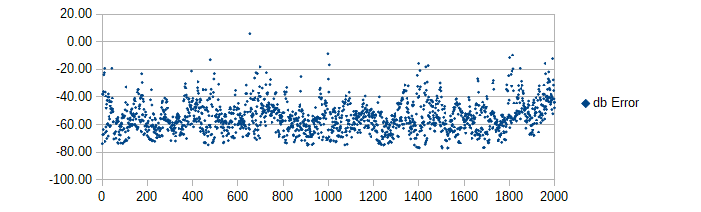
*ReIssues / ReMasters - Be wary when purchasing Reissues of long ago recorded projects. The temptation to 'improve' is irresistible among some record companies. In an effort to attract those weaned on SmartPhones, YouBoob, horribly compressed industrial noise and Whiner Rock, classic material is ReMastered. This may be a new digitization from seriously deteriorated
analog tapes or simply additional EQ and Compression to a decades old bit stream. In either case, results are often less than stellar. Some companies add copy protection to track pirated copies, which is clearly audible. Some are unlistenable. Click the thumbnail for an image of the delta magnitude over 2000 samples from Donald Fagan's Nightfly I.G.Y. This was not a ReMaster, but simply a release after the 1994 IFPI disk ID implementation and the label could not resist screwing it up.
† A note for vinylphiles: Try to obtain original pressings from the country of origin. Foreign pressings are made from EQ copies. The destination playback device will probably have an unequal response, both in the frequency and time domains, and generally muck up the sound. The mastering electronics, cutting lathe and master lacquer type all introduce other colorations. Over the years I've won many a wager against punters who claimed there could be no difference. After one such wager, the newly educated victim promptly ordered dozens of replacement LPs. He later claimed the improved 'software' made a greater contribution to his listening enjoyment than all his hardware replacements combined!
This YouTube video The TRUTH Why Modern Music is Awful is quite illuminating.
† A note for vinylphiles: Try to obtain original pressings from the country of origin. Foreign pressings are made from EQ copies. The destination playback device will probably have an unequal response, both in the frequency and time domains, and generally muck up the sound. The mastering electronics, cutting lathe and master lacquer type all introduce other colorations. Over the years I've won many a wager against punters who claimed there could be no difference. After one such wager, the newly educated victim promptly ordered dozens of replacement LPs. He later claimed the improved 'software' made a greater contribution to his listening enjoyment than all his hardware replacements combined!
This YouTube video The TRUTH Why Modern Music is Awful is quite illuminating.
Adding a Basement
Over the years we've owned several loudspeakers capable of reproducing almost all of the 10 octaves, Celestion Ditton 66s, KEF 105s, Tympani IIIs. While the Spicas excel in many areas, the first two octaves are not their strongest suit. Anechoically, the corner frequency is ~70Hz. In our room, this equates to about -10db in the mid 40s and -20 at 30Hz. Needless to say, tympani thwack do not have the same visceral impacts as in Carnegie Hall.
The addition of a Home Theater system last year got the grey matter cogitating that perhaps a sub woofer just might be the ticket to add missing heft. In the last century, sub woofer manufacturers were as scarce as hen's teeth. Today, every TD&H makes one. Just type 'powered subwoofer' in a web search engine and you'll get the idea.
Unprepared for the plethora of choices, yhc spent untold hours perusing websites and audio forums to rectify a distinct lack of erudition in the field. Sadly, much of what is posted is just fan-boy prattle. Quality, not quantity, our quest. Several vials of Visine later, one name consistently received high marks for musicality: REL. Subsequent auditions confirmed it.
With a baseline established, a cruise along the audio waterfront was in order to find the high water mark. We needn't have bothered. Almost universally, audio purveyors are incapable of demonstrating a standard HiFi system satifactorily. Adding a subwoofer ensures it. Chuff and Puff, Thud and Rumble, Boom, Bloat and Blur!! Have these people ever heard unamplified live music? One thinks not, given their enthused comments!
We did hear some homogeneous systems with subwoofers where all components are from the same manufacturer and the subwoofer is designed to compliment the primaries. Unfortunately, using subwoofer B with speaker A or vice versa immediately brought the sonic characters in to sharp contrast. As we have no intention of replacing the Spicas, another option was required.
A REL Strata III in Light Oak is only available as an $1800 non refundable Special Order... an alternative had to be found. Frequent searches on eBay, Audiogon and AudioAsylum turned up many possibilities. Just as I was about commit to a purchase of a used REL, I came across interesting references to Audio Concepts Titan LE and Force subwoofers and their musicality vis a vis the REL. More Visine, s'il vous plait...
We decided to give the Force an audition. Audio Concepts sells direct to the consumer with a 30 day 100% No Questions guarantee. We give our unqualified recommendation to the company for service and support. Should you need more than 30 days, they'll extend your evaluation period. 16 digits and four days later, the Force, in Light Oak, arrived, very well packed. Sadly, Audio Concepts is no more.
Now the fun begins...
We used the Zone 2 output of our Rotel RX-1050 to drive the Force at line level.
My first thoughts were to ease the load on the Spicas, inserting a HiPass filter in the amplifier line. We tried 72Hz, both First and Second Order. While the transient response on the bottom of the Spicas improved, there is just too much tonal diversity relative to the Force in our den for this to be an acceptable solution.
No manner of adjustment of crossover frequency or slope or phase resulted in any improvement. Soundstage diminished, the bass became wooly and ill defined, focus non existent. As these sonic deficiencies are difficult to ascribe to an increase in low frequency level, I began thinking that perhaps the Zone 2 output was the contributing factor...
How bad can 4 inches of wire sound?
We purchased a pair of Radio Shack Gold Series 42-2536 Y Adapters, 1M-2F. In previous lifetimes, we often were astounded at the improvements made in recording kit by replacing the volume pot wiring with something better than the OEM twist tie. In this instance, I was utterly DUMBFOUNDED at the DEGRADATION caused by these adapters. Grey, gritty grunge on a cardboard panel half the size of our listening space! Back to Zone 2...
Several unsatisfactory hours later, it dawned on me that perhaps the Rotel was indeed the culprit due to inadequate buffering. I turned off the Force and compared the sound with Zone 2 enabled and disabled. Surprisingly, enabling Zone 2 caused the very effects I was ascribing to the Force: Diminished soundstage, wooly bass, non existent focus. Removing the cables from the Zone 2 outputs reduced, but did not remove, the differences. Turning Zone 2 OFF removed the defects entirely. Additional investigation showed that further very subtle improvements are available by selecting a backshorted input for the REC path. And, the B Speaker terminals are less grating in the upper mids.
Most subwoofers today are capable of accepting Speaker or Line Level inputs as a signal source. The REL uses separate connectors, the Force via a -17.7db speaker terminal to RCA line level adapter. [Both methods have their merits and limitations. The Force adapters better isolate a long run of cable from the amp to the subwoofer at the expense of presenting a slightly higher impedance to the subwoofer input.] No discernible degradation could be ascertained from the paralleling of Spicas and adapters.
As I was essentially starting over, I chose to ignore the setup instructions and use the same methodology used in the past to set up recording studio loudspeakers, a combination of tools and listening.
The addition of a Home Theater system last year got the grey matter cogitating that perhaps a sub woofer just might be the ticket to add missing heft. In the last century, sub woofer manufacturers were as scarce as hen's teeth. Today, every TD&H makes one. Just type 'powered subwoofer' in a web search engine and you'll get the idea.
Unprepared for the plethora of choices, yhc spent untold hours perusing websites and audio forums to rectify a distinct lack of erudition in the field. Sadly, much of what is posted is just fan-boy prattle. Quality, not quantity, our quest. Several vials of Visine later, one name consistently received high marks for musicality: REL. Subsequent auditions confirmed it.
With a baseline established, a cruise along the audio waterfront was in order to find the high water mark. We needn't have bothered. Almost universally, audio purveyors are incapable of demonstrating a standard HiFi system satifactorily. Adding a subwoofer ensures it. Chuff and Puff, Thud and Rumble, Boom, Bloat and Blur!! Have these people ever heard unamplified live music? One thinks not, given their enthused comments!
We did hear some homogeneous systems with subwoofers where all components are from the same manufacturer and the subwoofer is designed to compliment the primaries. Unfortunately, using subwoofer B with speaker A or vice versa immediately brought the sonic characters in to sharp contrast. As we have no intention of replacing the Spicas, another option was required.
A REL Strata III in Light Oak is only available as an $1800 non refundable Special Order... an alternative had to be found. Frequent searches on eBay, Audiogon and AudioAsylum turned up many possibilities. Just as I was about commit to a purchase of a used REL, I came across interesting references to Audio Concepts Titan LE and Force subwoofers and their musicality vis a vis the REL. More Visine, s'il vous plait...
We decided to give the Force an audition. Audio Concepts sells direct to the consumer with a 30 day 100% No Questions guarantee. We give our unqualified recommendation to the company for service and support. Should you need more than 30 days, they'll extend your evaluation period. 16 digits and four days later, the Force, in Light Oak, arrived, very well packed. Sadly, Audio Concepts is no more.
Now the fun begins...
We used the Zone 2 output of our Rotel RX-1050 to drive the Force at line level.
My first thoughts were to ease the load on the Spicas, inserting a HiPass filter in the amplifier line. We tried 72Hz, both First and Second Order. While the transient response on the bottom of the Spicas improved, there is just too much tonal diversity relative to the Force in our den for this to be an acceptable solution.
No manner of adjustment of crossover frequency or slope or phase resulted in any improvement. Soundstage diminished, the bass became wooly and ill defined, focus non existent. As these sonic deficiencies are difficult to ascribe to an increase in low frequency level, I began thinking that perhaps the Zone 2 output was the contributing factor...
How bad can 4 inches of wire sound?
We purchased a pair of Radio Shack Gold Series 42-2536 Y Adapters, 1M-2F. In previous lifetimes, we often were astounded at the improvements made in recording kit by replacing the volume pot wiring with something better than the OEM twist tie. In this instance, I was utterly DUMBFOUNDED at the DEGRADATION caused by these adapters. Grey, gritty grunge on a cardboard panel half the size of our listening space! Back to Zone 2...
Several unsatisfactory hours later, it dawned on me that perhaps the Rotel was indeed the culprit due to inadequate buffering. I turned off the Force and compared the sound with Zone 2 enabled and disabled. Surprisingly, enabling Zone 2 caused the very effects I was ascribing to the Force: Diminished soundstage, wooly bass, non existent focus. Removing the cables from the Zone 2 outputs reduced, but did not remove, the differences. Turning Zone 2 OFF removed the defects entirely. Additional investigation showed that further very subtle improvements are available by selecting a backshorted input for the REC path. And, the B Speaker terminals are less grating in the upper mids.
Most subwoofers today are capable of accepting Speaker or Line Level inputs as a signal source. The REL uses separate connectors, the Force via a -17.7db speaker terminal to RCA line level adapter. [Both methods have their merits and limitations. The Force adapters better isolate a long run of cable from the amp to the subwoofer at the expense of presenting a slightly higher impedance to the subwoofer input.] No discernible degradation could be ascertained from the paralleling of Spicas and adapters.
As I was essentially starting over, I chose to ignore the setup instructions and use the same methodology used in the past to set up recording studio loudspeakers, a combination of tools and listening.
- Turn crossover all the way down to 35Hz / 24db octave
- Using Pink Noise, adjust subwoofer level to equal mid band level on RTA at listening position
- Increase crossover frequency to achieve maximally flat response
- Adjust Phase for maximum low frequency amplitude
- Adjust Level for even amplitude response
- Check with Warble and Swept Frequency tests
Listen! Tweak!
Listen! Tweak!
Listen! Tweak! ...
...and the tympani are visceral!
From cellar to ceiling, we're awash in the ambiance of Joni Mitchell's exquisite Travelogue ... Frank Sinatra's back in the old Studio A at Capitol Records, not some rootless replica.
An articulate, extended and veracious low end adds realism out of all proportion to the numbers.
[Those little speakers aren't putting out all that gorgeous bass?!?!?!?!? - No, there's a Force subwoofer at the end of the sofa. - Every other subwoofer I've ever heard just boomed!]**
For more information on the ins, outs & vagaries of subwoofer integration, see Subterranean Homesick Blues
Power CONditioning
While paddling the audio littoral, we encountered several chassis labeled "Monster Power" and "Panamax". Inquiry as to the import of said boxes revealed they were "power CONditioners." Old enough to recall the argument between Tesla and Edison whether AC or DC was the preferred method of power transmission, "Uh, huh" and "Yeah, right" summed the level of interest.
A chronic thirst for knowledge, and armed with first hand knowledge that Monster Cable is an astute marketing organization, I trundled over to monstercable.com to get the buzz, or perhaps reduction thereof.
One can find $2500*** power cords, $80*** wall receptacles and apparently the sky is the limit for power CONditioners. The astute may have noticed the UpperCase CON! If P.T. Barnum were alive today, he might be in the power CONditioner business. Never one to leave a stone unturned, I decided to see how old P.T. would peg me...
***add a Zero or two per decade or so...
I'll preface here that the Rotel RX-1050 incorporates its own internal LC network to accomplish the job of an external power CONditioner, namely remove noise from the AC before it contaminates the audio signal in the electronic circuitry. [Tesla was correct!] What enhancement / detriment the built in LC network contributes to our results is unknown. Regardless, we're fortunate to have a new power transformer at the end of our driveway providing us with very clean and stable 117VAC. Expecting the additional CONtribution of an external device to fall on the low side of slim and non existent, we opted to critically listen for subtle system changes rather than engage in a comparison of competing units. As you read, please remember YMMV...
Sans datum and compass, I induced several loans of sundry mid price devices : Models 5300 and 5100 from Panamax, HTS-3600 and HTS-3500 MkII from Monster Cable, and at the upper end of the mid price spectrum, a Furman RI-1220. Over the next several weekends, each device was individually evaluated to determine its merits.
The first device evaluated was the Panamax 5300. Quite simply, we were utterly unprepared prepared for the improvement! Dynamics are expanded and more refined. The blackness between instruments is darker. Mumbly vocalists retroactively receive diction lessons. One could be forgiven for thinking some subtle midrange EQ effect is induced, were it not for the increased clarity extending from tympani thwacks through trumpet trills to tiny triangles.
Serendipity be damned, this is one of the most significant improvements in 40+ years of the quest!! YMMV
From a quick read of the Panamax literature on-line, the primary difference between the 5300 and 5100 appears to be the meter and the front panel convenience outlet. Never one to squander a farthing, a $150 lower cost induced me to try the 5100. Nice. No cigar. YMMV.
The Monster products are a different kettle of fish. Unprepared as we were for the Panamax improvements, flabbergasted was the response to the Monsters. Pages of notes about disembodied sopranos, woodless acoustic guitars, splatty cymbals, wiry celli, ad nauseum... I needn't have bothered! On first listen Marylou declared "It's COLD!" As in "AMUSICAL!" As in "Turn the bloody thing off and send it back! NOW!" So much for my finely nuanced descriptive excreta...
The Furman RI-1220 was smooth as silk and four times as expensive. One needs better ear$ and much better equipment to appreciate it fully.
The take away from the above is that one is building a system and components may enhance, detract or have no effect at all. In a different system, the Monster products may have come out best with Panamax last. YMMV
The Panamax 5300 is the last [first?] link in our HiFi chain. We began with loudspeakers, added electronics, cables next, a subwoofer and finally a power conditioner. It revised our biases on what contributes significantly to realistic reproduction.
I wonder if DWP has any edge wound silver power transformers that require evaluation...
Should you opt to try similar power conditioning devices, take great care in connecting devices. We configured ours as two separate systems. The primary is HiFi Audio. The secondary, Home Theater. The Panamax 5300 is the single common point. One could negate any improvement by cross connecting between HiFi and HT [aka Radio with Pictures].
2019 update: The Panamax now feeds the marantz CD6006 from the unswitched section, A/V power amp is fed from High Current section and TV from the switched. Subs and HiFi power amps fed directly from the wall outlet.
A chronic thirst for knowledge, and armed with first hand knowledge that Monster Cable is an astute marketing organization, I trundled over to monstercable.com to get the buzz, or perhaps reduction thereof.
One can find $2500*** power cords, $80*** wall receptacles and apparently the sky is the limit for power CONditioners. The astute may have noticed the UpperCase CON! If P.T. Barnum were alive today, he might be in the power CONditioner business. Never one to leave a stone unturned, I decided to see how old P.T. would peg me...
***add a Zero or two per decade or so...
I'll preface here that the Rotel RX-1050 incorporates its own internal LC network to accomplish the job of an external power CONditioner, namely remove noise from the AC before it contaminates the audio signal in the electronic circuitry. [Tesla was correct!] What enhancement / detriment the built in LC network contributes to our results is unknown. Regardless, we're fortunate to have a new power transformer at the end of our driveway providing us with very clean and stable 117VAC. Expecting the additional CONtribution of an external device to fall on the low side of slim and non existent, we opted to critically listen for subtle system changes rather than engage in a comparison of competing units. As you read, please remember YMMV...
Sans datum and compass, I induced several loans of sundry mid price devices : Models 5300 and 5100 from Panamax, HTS-3600 and HTS-3500 MkII from Monster Cable, and at the upper end of the mid price spectrum, a Furman RI-1220. Over the next several weekends, each device was individually evaluated to determine its merits.
The first device evaluated was the Panamax 5300. Quite simply, we were utterly unprepared prepared for the improvement! Dynamics are expanded and more refined. The blackness between instruments is darker. Mumbly vocalists retroactively receive diction lessons. One could be forgiven for thinking some subtle midrange EQ effect is induced, were it not for the increased clarity extending from tympani thwacks through trumpet trills to tiny triangles.
Serendipity be damned, this is one of the most significant improvements in 40+ years of the quest!! YMMV
From a quick read of the Panamax literature on-line, the primary difference between the 5300 and 5100 appears to be the meter and the front panel convenience outlet. Never one to squander a farthing, a $150 lower cost induced me to try the 5100. Nice. No cigar. YMMV.
The Monster products are a different kettle of fish. Unprepared as we were for the Panamax improvements, flabbergasted was the response to the Monsters. Pages of notes about disembodied sopranos, woodless acoustic guitars, splatty cymbals, wiry celli, ad nauseum... I needn't have bothered! On first listen Marylou declared "It's COLD!" As in "AMUSICAL!" As in "Turn the bloody thing off and send it back! NOW!" So much for my finely nuanced descriptive excreta...
The Furman RI-1220 was smooth as silk and four times as expensive. One needs better ear$ and much better equipment to appreciate it fully.
The take away from the above is that one is building a system and components may enhance, detract or have no effect at all. In a different system, the Monster products may have come out best with Panamax last. YMMV
The Panamax 5300 is the last [first?] link in our HiFi chain. We began with loudspeakers, added electronics, cables next, a subwoofer and finally a power conditioner. It revised our biases on what contributes significantly to realistic reproduction.
I wonder if DWP has any edge wound silver power transformers that require evaluation...
Should you opt to try similar power conditioning devices, take great care in connecting devices. We configured ours as two separate systems. The primary is HiFi Audio. The secondary, Home Theater. The Panamax 5300 is the single common point. One could negate any improvement by cross connecting between HiFi and HT [aka Radio with Pictures].
2019 update: The Panamax now feeds the marantz CD6006 from the unswitched section, A/V power amp is fed from High Current section and TV from the switched. Subs and HiFi power amps fed directly from the wall outlet.
⇒ 15 years - 2017
Last Hurrah
[Click Thumbnails for a larger image]
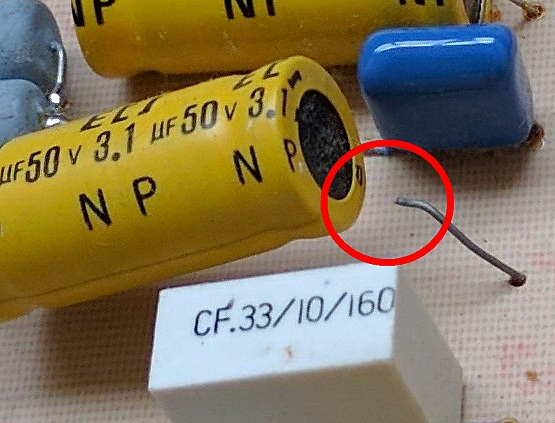
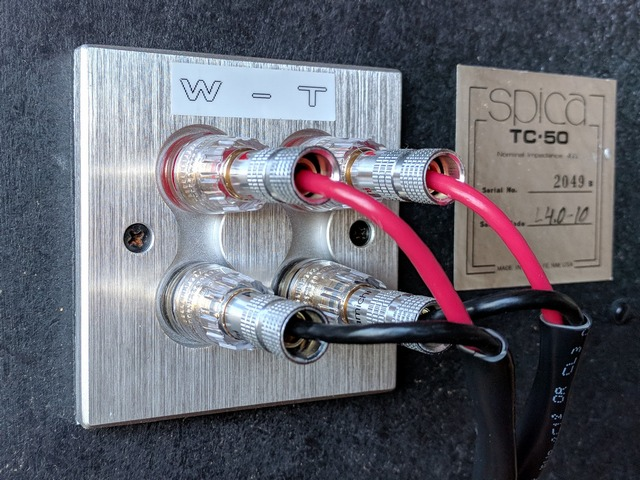
After 30+ years, one of the capacitor leads in a TC-50 had suffered metal fatigue and the sound 'buzzed' in one channel at moderate levels. The electrolytic caps' capacitance still measured better than spec, but that can be misleading as the ESR was probably much higher. 30+ years is more than double the recommended de-rated electrolytic 15 year life. All electrolytic caps were replaced with Erse Pulse X Polypropylene. Since we had the speakers apart, might as well Bi-Wire. See Cable Snake Oil BiWire
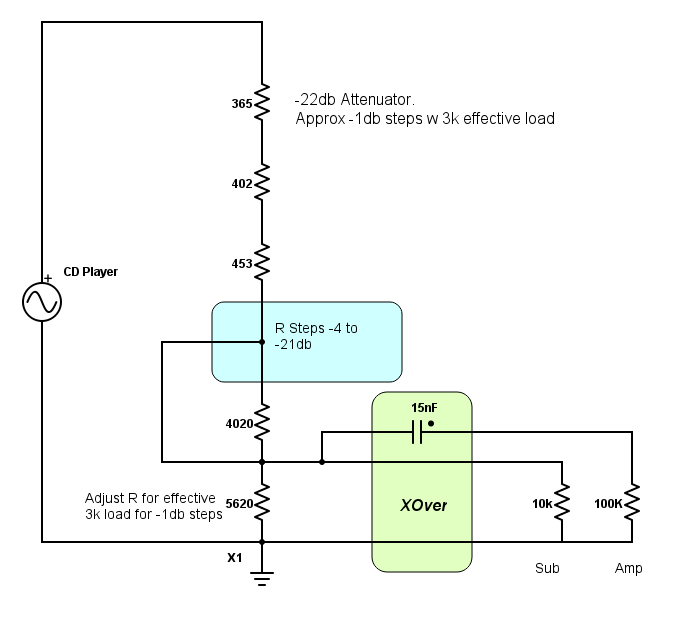
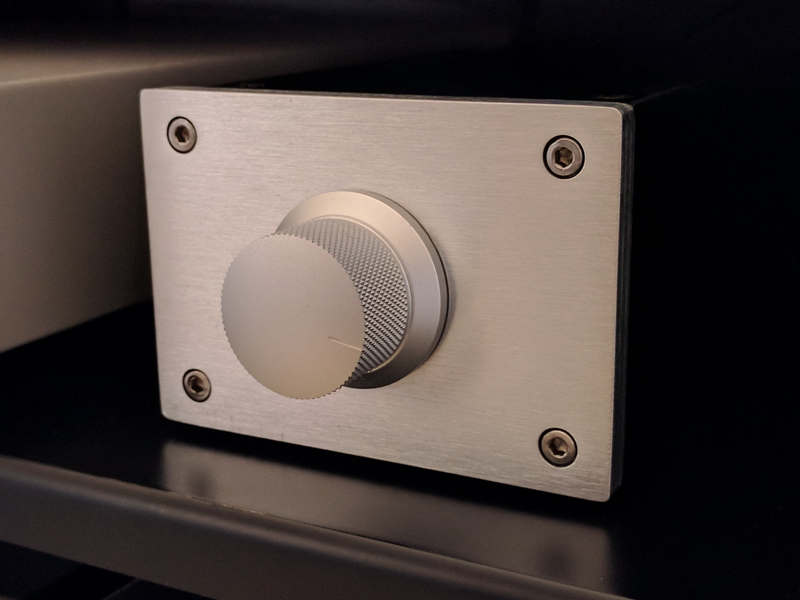
Since the Rotels were now 15 years old and we have no need of a tuner, an upgrade beckoned. We replaced the RX-1050 with the LC1 self-designed 0 to -22db passive Level Control, a passive XOver and a PrimaLuna ProLogue Five. The PL5 can be very engaging, but struggles driving the 3.6Ω to 12Ω 85db/w/m TC-50s at anything above moderate level. A NuPrime ST-10✝ provides plenty
Since the Rotels were now 15 years old and we have no need of a tuner, an upgrade beckoned. We replaced the RX-1050 with the LC1 self-designed 0 to -22db passive Level Control, a passive XOver and a PrimaLuna ProLogue Five. The PL5 can be very engaging, but struggles driving the 3.6Ω to 12Ω 85db/w/m TC-50s at anything above moderate level. A NuPrime ST-10✝ provides plenty
of musical oomph when required. See Tu-be Or Not Tu-be for case temperature tribulations. Interestingly, the Transparent / PrimaLuna combination produces an exaggerated sound stage depth. Late 80's Monster Cable Pro pre-production provide just the right sound stage and balance, just as they did 30+ years ago with my custom KT88 space heater. The RCD-02 was updated by John Bau of Spica fame to linearize the power supplies. John's idea is that power supplies are not phase coherent and the anomalies impart their non-linearities into the music. The change is nothing short of astounding. After a very long warm-up, it was like being back in the control room. Other than maximum level, it is as close as I've ever heard on ANY hi-fi to a studio presentation. Unfortunately, the ancient DAC is less than ideal and very susceptible to thermal variations affecting the filters. A marantz CD6006 augments its duty. It has a USB port, permitting download playback without the need for an external DAC. marantz claims to use mirror image discrete audio electronics with particular attention paid to power supplies. Hyperbole aside, it is very good and reasonably priced.
While we were at it, we modeled the Force sub amp in Spice to understand and correlate the panel controls with what we are hearing. See Subterranean Homesick Blues for more information.
⇒ 1 years - 2018
The Smallest of Things
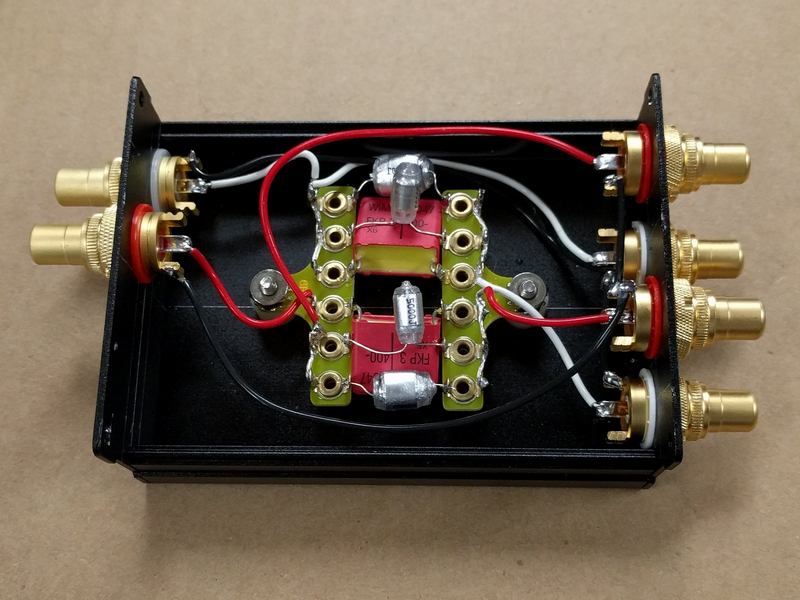
We had been using the Spica Passive Interface to roll off the low end from the TC-50s @ ~105Hz. This is a simple series capacitor whose value is determined by the amplifier input impedance as shown in the LC1 schematic above. It's contained in a plastic box with generic RCA connectors. As HiFi Jewelry is part of this addiction, I decided to fabricate a prettier, more robust and easier to modify version, hence the XO1 at left. Caps are WIMA FKP3 Polypropylene and Xicon Polystyrene. Wire is silver plated OFC 20ga w PTFE [Teflon] insulation. Since it was now obvious I'd suffered a complete relapse, I decided to replace the PET [Mylar] caps in the TC-50 crossover as well. As ERSE was out of stock on some values, I opted to use Dayton Audio Capacitors. I've used them to recap several sets of RS Minimus 7 and other projects. Values are spot on and the sound quality is excellent.
Having given up just listening decades ago, my normal M.O. is to read while enjoying the music. A few minutes into the music, I found my foot tapping uncontrollably. A few minutes later, I put the book down and just listened. FOR FIVE HOURS!!! Everything I played was just stunning. Focus is incredible. Previously solo piano was always a little nebulous sort of moving as the octaves changed. Now the instrument is spread out properly as I used to mic it. It's an even balance within the image width. Miles' horn is sweeter than ever. Early minimally mic'd stereo jazz recordings are alive! Perspective is better, with more cushion. On Toto's 'Rosanna', there is a very quiet low backing voice clearly separate from the chorus that I don't ever recall. Basses are more focused in dense orchestra. Tympani and percussion are precisely situated and don't wander when the score gets really dense. 'Underture' from Tommy is massive. Tim Pierce's guitar work in 'Toy Matinée' is more brilliant. Bolero builds until I'm fairly pressed into the chair. The system is not hyper focused, it's as natural a perspective as I think I've ever heard. Pop recordings have their multi-verb pseudo depth even more clearly delineated. Well recorded classics in good halls are just gorgeous. Image height and vertical placing is as good or better than I've ever heard. The speakers are next to invisible. If I close my eyes, they just disappear. The system emotes!
⇒ 1 years - 2019
Double, Double, Toil and Trouble
Knowing full well that the Belden 1311A and banana connectors were probably not an optimum solution, I investigated many BiWire options. Sadly, most do not appear to be soundly engineered and little more than marketing malarkey. One that stood out from a technical perspective is the Kimber Bi‑Focal XL series. While costing several multiples of the TC-50, they do an outstanding job in the system. Image is expanded, more cohesive and focused, mid-bass is tighter, mids are more focused, upper-mids less glassy, highs smooth and extended. Soundstage is better defined from top to bottom and side to side. YMMV
Again, knowing full well that a single sub is less than optimum with small monitors and higher XO frequencies, I went on a fruitless hunt for a used Force. Plan B.
Requirements:
• Continuous Phase Control
• Phase Invert
• Multi Slope XO Frequency
• Down Firing
• Sealed
• Independent Music and LFE Inputs
Only a few subs meet all of the above criteria. One make that does is the Martin Logan Dynamo Series. As the 10' Force had mated excellently with the TC-50, we opted for the 800x model. Strong factors in favor of the ML Dynamo are the ability to setup with a smart-phone and the inclusion of Anthem ARC. With the ML control app, the user can adjust all sub parameters from the listening position. It is insanely easy select XO Freq, Slope, Phase, Level while listening in real time. Loop a section and a precise dial-in becomes a trivial, minutes long doddle instead of a seemingly endless ordeal! No more crawling over / behind the sub with flashlight and mirror! ARC is available as a smart-phone app and works reasonably well at taming room faults. IMO, better results are obtained with calibrated microphone and the PBK - Perfect Bass Kit on a PC. Patience pays large dividends. Recommend about 50 hours playing before final calibration and tweaking.
Requirements:
• Continuous Phase Control
• Phase Invert
• Multi Slope XO Frequency
• Down Firing
• Sealed
• Independent Music and LFE Inputs
Only a few subs meet all of the above criteria. One make that does is the Martin Logan Dynamo Series. As the 10' Force had mated excellently with the TC-50, we opted for the 800x model. Strong factors in favor of the ML Dynamo are the ability to setup with a smart-phone and the inclusion of Anthem ARC. With the ML control app, the user can adjust all sub parameters from the listening position. It is insanely easy select XO Freq, Slope, Phase, Level while listening in real time. Loop a section and a precise dial-in becomes a trivial, minutes long doddle instead of a seemingly endless ordeal! No more crawling over / behind the sub with flashlight and mirror! ARC is available as a smart-phone app and works reasonably well at taming room faults. IMO, better results are obtained with calibrated microphone and the PBK - Perfect Bass Kit on a PC. Patience pays large dividends. Recommend about 50 hours playing before final calibration and tweaking.
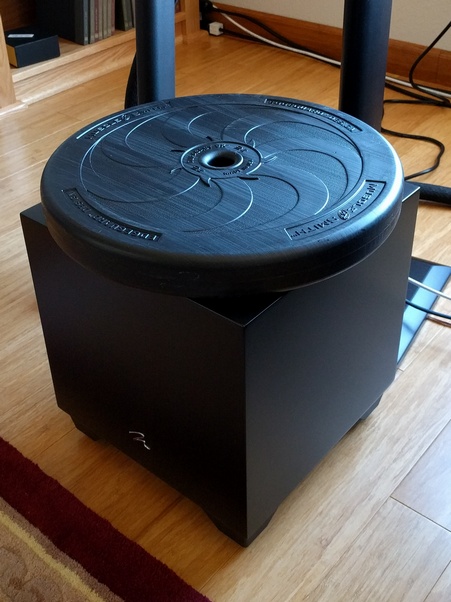
With two subs, the image is larger. Lower register instruments like string bass, bass clarinet, baritone sax are less prone to strolling. Foot, bass, tympani are better focused. Vocalist location in more precisely defined. Soundstage is expanded in the lower registers to more closely match the mid and up registers.
The subs barely get warm even after hours of extended and robust use. This was a concern with the Force on some old recordings with no low end room filter and some film LFE.
Only negative is the subs are too light, as would be all similarly sized units, when installed in a 2nd story room. Our media room is above our 750ft² three car garage and only supported at its periphery. The unsupported floor can be made to rattle and consequently, the subs will stroll. An effective solution is a 10kg barbell weight, anchored with Sorbothane, atop each sub.
The subs barely get warm even after hours of extended and robust use. This was a concern with the Force on some old recordings with no low end room filter and some film LFE.
Only negative is the subs are too light, as would be all similarly sized units, when installed in a 2nd story room. Our media room is above our 750ft² three car garage and only supported at its periphery. The unsupported floor can be made to rattle and consequently, the subs will stroll. An effective solution is a 10kg barbell weight, anchored with Sorbothane, atop each sub.
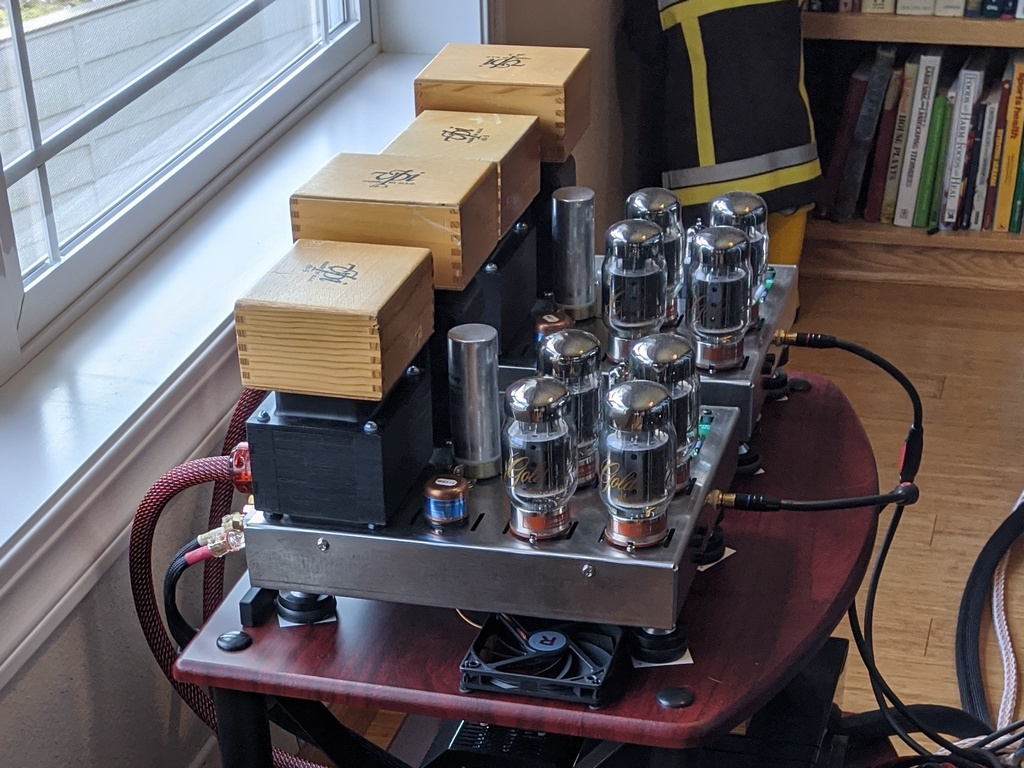
Wanting a little more power than the PL5 with a little more liquidity than the NuPrime ST-10✝, we purchased a pair of factory built Tubes4HiFi / VTA M-125's. This less than enjoyable experience is detailed in teaching the Tubes4HiFi / VTA M-125 to sing.
When properly built, the M-125 is an effortless amp to enjoy. Full range with TC-50s or as the mid driver in the LFT-8b, the music is palpable. Dynamics are excellent. There's no confusion between a close mic'd studio album and an opera recorded with three tube microphones on a tube recorder in 1958. Perspective, dynamics and studio trickery are accurately rendered.
When properly built, the M-125 is an effortless amp to enjoy. Full range with TC-50s or as the mid driver in the LFT-8b, the music is palpable. Dynamics are excellent. There's no confusion between a close mic'd studio album and an opera recorded with three tube microphones on a tube recorder in 1958. Perspective, dynamics and studio trickery are accurately rendered.
Every so often, microphone cal is checked and I sweep the system and also driver by driver and compare levels to possibly detect any impending failures. I also note playback settings on the CD case so the part that changes is I get older.

It's important to keep track of tube hours. Removing tubes to test is hard on them. A soft start to limit inrush current gives a few seconds for the heaters to warm at a reduced rate thus reducing thermal stress.
Power tubes have much shorter life than most driver tubes, so if the amp was sounding fine when it came time to replace the power tubes, just leave the drivers in the amp.
Power tubes have much shorter life than most driver tubes, so if the amp was sounding fine when it came time to replace the power tubes, just leave the drivers in the amp.
I love it when a Planar comes together
As much as I love the TC-50, ever since I first heard a mono Quad ESL-57 in the mid 60's, planar speakers have held a fascination. They have a certain magic (and long list of imperfections) that I find seductive. Not having a room as I did in the 80's to house a set of large Magnepans, I toyed with other options: newer Quads, Martin-Logans and other less well known and somewhat more esoteric marques.
By chance, I discovered the Eminent Technology LFT-8b and subsequent research induced me to spring for a set. As I had 4 amplifiers, well 2 [ST-10✝ & PL5] and a bit [2x M-125s], I thought it might be fun to tri-amp the LFT–8b. Subsequent individual measurements of the woofer and panels led me to abandon my self-designed analog XOver in favor of DSP. Bruce Thigpen, inventor of the LFT panel, is an all around genuinely nice guy who provided unstinting help and advice on integrating and tweaking the LFT-8b for the tri-amp project.
Extensive investigation of available self-contained, not PC app, DSP led me to opt for a pair of miniDSP 2x4HD, later replaced with 4x10Hd due to impossibly difficult and bad level and preset synchronization between two 2x4HD. Sadly, the 4x10Hd is more than somewhat veiled and suffers even more severely from a miniDSP familial failing: Levels changes are not accurately tracked. Whether by mindDSP or learned 3rd party remote or by 4x10Hd front panel control, a ±step change can vary between 0 and ±1.5. The only way to accurately set levels is with the computer plug-in. There is a brain dead smartphone app rated 1★ as Zero is not available : "Almost DANGEROUS. Lacks numeric feedback on level. The slider is very imprecise, basically just more and less. Level control slider is linear from min to max, thus same resolution at -70 as +4. A misplaced tap can get VERY LOUD!!! Requires relinking multiple devices every time. NO SECURITY: Password not required to connect. If you are on the network, have at it. When using the miniDSP plug-in application, this app cannot connect and just spins. If the phone goes to sleep while connected, the devices are locked out from the PC plug-in."
miniDSP WiFi interface WI-DG can corrupt 2x4HD configurations and while not bricking the 2x4HD can render it DoA requiring a HARD RESET and complete reconfiguration. Never purchase direct from miniDSP Hong Kong! Getting service and return shipping is a nightmare.
Control with miniDSP Remote v2 monitored over USB in the cludgy miniDSP plug-in. Even the V2 remote is not 100% reliable. Counting clicks in the 21st century has a distinctly medieval flavor. It is a system wide failing as the 4x10HD gave between 0 and ±1.5dB per remote or built-in control click.
Note: miniDSP 2x4HD analog inputs suffer badly from less than stellar ADC
As no good deed goes unpunished, about the time I got them set up the M-125 build error and red-plating nightmares began
... and then 2020.
✝ NuPrime ST-10 had a relatively short life, less than 4 years. Initially, the mini PSU that controls the soft-start failed, rendering a $1600 amplifier DoA. Modified to remove the soft-start as it was redundant with the full system soft-start.
By chance, I discovered the Eminent Technology LFT-8b and subsequent research induced me to spring for a set. As I had 4 amplifiers, well 2 [ST-10✝ & PL5] and a bit [2x M-125s], I thought it might be fun to tri-amp the LFT–8b. Subsequent individual measurements of the woofer and panels led me to abandon my self-designed analog XOver in favor of DSP. Bruce Thigpen, inventor of the LFT panel, is an all around genuinely nice guy who provided unstinting help and advice on integrating and tweaking the LFT-8b for the tri-amp project.
Extensive investigation of available self-contained, not PC app, DSP led me to opt for a pair of miniDSP 2x4HD, later replaced with 4x10Hd due to impossibly difficult and bad level and preset synchronization between two 2x4HD. Sadly, the 4x10Hd is more than somewhat veiled and suffers even more severely from a miniDSP familial failing: Levels changes are not accurately tracked. Whether by mindDSP or learned 3rd party remote or by 4x10Hd front panel control, a ±step change can vary between 0 and ±1.5. The only way to accurately set levels is with the computer plug-in. There is a brain dead smartphone app rated 1★ as Zero is not available : "Almost DANGEROUS. Lacks numeric feedback on level. The slider is very imprecise, basically just more and less. Level control slider is linear from min to max, thus same resolution at -70 as +4. A misplaced tap can get VERY LOUD!!! Requires relinking multiple devices every time. NO SECURITY: Password not required to connect. If you are on the network, have at it. When using the miniDSP plug-in application, this app cannot connect and just spins. If the phone goes to sleep while connected, the devices are locked out from the PC plug-in."
miniDSP WiFi interface WI-DG can corrupt 2x4HD configurations and while not bricking the 2x4HD can render it DoA requiring a HARD RESET and complete reconfiguration. Never purchase direct from miniDSP Hong Kong! Getting service and return shipping is a nightmare.
Control with miniDSP Remote v2 monitored over USB in the cludgy miniDSP plug-in. Even the V2 remote is not 100% reliable. Counting clicks in the 21st century has a distinctly medieval flavor. It is a system wide failing as the 4x10HD gave between 0 and ±1.5dB per remote or built-in control click.
Note: miniDSP 2x4HD analog inputs suffer badly from less than stellar ADC
As no good deed goes unpunished, about the time I got them set up the M-125 build error and red-plating nightmares began
... and then 2020.
✝ NuPrime ST-10 had a relatively short life, less than 4 years. Initially, the mini PSU that controls the soft-start failed, rendering a $1600 amplifier DoA. Modified to remove the soft-start as it was redundant with the full system soft-start.
⇒ 2 years - 2021
Done & Dusted
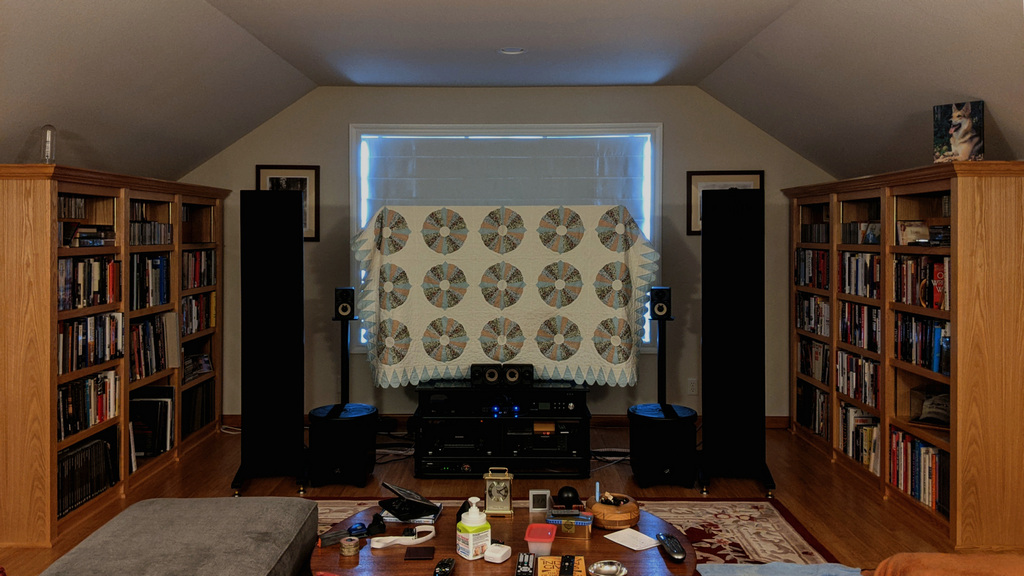
REW aka Room Eq Wizard supports miniDSP and allows BiQuad IIR digital filter design. This enables better control than the standard miniDSP's built in Parametric EQ. REW sums filter response and measurement to give an anticipated response. REW can also calculate the time delta between the cone woofer, the subs and the panels to time align the drivers. However, we found calculated values required audible adjustment for the best coherence in our system. Working iteratively using multiple configurations, dial-in is fairly straight forward.
As we don't have an anechoic chamber, we used measurements at the driver, several fixed distances and Moving Microphone Measurements of individual drivers and full range. Then we listen A LOT! before making further adjustments.
• October 2022 we sprung for the miniDSP Flex-8. Finally, a miniDSP ready for prime time. Front panel level control & display complete with 100% accurate level adjustment!
Flex-8 Input:
• S/PDIF from the marantz cd6006 as it's just a little better than the TosLink.
Flex-8 Output:
* no longer available
As cables are tone controls [see Cable Snake Oil Antidote], each cable mated to its load, function in this room in this system. As always, YMMV.
• March 2022 ... Final woofer upgrade to Parts Express Dayton Audio RS225-8. By far the best match to the mid-panel requiring a much less aggressive XO filter to mate with the mid panel than either the Tymphany SLS-P83067 or the stock Usher 8137A.
Chesky Records' tag "Our philosophy is simple: to create the illusion of live musicians in a real three-dimensional space." has always been the guiding light. Effortless best describes the system.
Done & Dusted
• October 2024 - M-125 quad manual bias, Bias Meters, new Apex Matched KT88s. see back 2 BASIC
• February 2025 - WiiM Pro Plus streamer & TosLink switch to interface to Flex Eight
• November 2025 - Inday DA4X-R S/PDIF switch to interface all sources electrically to Flex Eight.
• October 2022 we sprung for the miniDSP Flex-8. Finally, a miniDSP ready for prime time. Front panel level control & display complete with 100% accurate level adjustment!
Flex-8 Input:
• S/PDIF from the marantz cd6006 as it's just a little better than the TosLink.
Flex-8 Output:
- • Subs: 2x Martin-Logan 800x: heavy duty double shielded video cable*
- • Woofer: 2x Outlaw M2220: ancient Monster Reference prototypes*, output HannLinte Braided OFC 10AWG*
- • Mid panel: 2x ieLogical M-125s: Transparent MusicLink, output Kimber Monocle XL
- • Tweeter panel: PrimaLuna PL5: Hitachi OFC microphone cable*, output HannLinte Braided OFC 10AWG*
* no longer available
As cables are tone controls [see Cable Snake Oil Antidote], each cable mated to its load, function in this room in this system. As always, YMMV.
• March 2022 ... Final woofer upgrade to Parts Express Dayton Audio RS225-8. By far the best match to the mid-panel requiring a much less aggressive XO filter to mate with the mid panel than either the Tymphany SLS-P83067 or the stock Usher 8137A.
Chesky Records' tag "Our philosophy is simple: to create the illusion of live musicians in a real three-dimensional space." has always been the guiding light. Effortless best describes the system.
Done & Dusted
• October 2024 - M-125 quad manual bias, Bias Meters, new Apex Matched KT88s. see back 2 BASIC
• February 2025 - WiiM Pro Plus streamer & TosLink switch to interface to Flex Eight
• November 2025 - Inday DA4X-R S/PDIF switch to interface all sources electrically to Flex Eight.
** Todd Yvega Synclavier Genius and Frank Zappa Software Surgeon Duckman Composer Digital Audio maven for the BIGs |